
Logan and Albert Conservation Association
General articles relating to Australian Fauna
BARN Brisbane Area Rescue Network is an active WILDLIFE CARERS group rescuing and rehabillitating wildlife in western Logan. You woud be amazed at the number and range of animals needing assistance. They provide some great tips that we can all adopt to help reduce injuries, trauma and fatalities on their FACEBOOK page.
The list is by no means exhaustive or in a particular order and suggestions or ideas of what others are doing to help are welcomed.
HELPING INJURED OR DISPLACED WILDLIFE and other animals
Wildcare Australia Inc is a non-profit organization situated in South East Queensland. The organization was originally formed as the Australian Koala Hospital Association Incorporated in late 1993 by Dr Jonathon Hanger. It became an Incorporated Association and registered charity in 1994 and is listed on the Register of Environmental Organizations.
Wildcare Australia volunteers man a 24 hours 7days a week Emergency hotline for SOUTHEAST QUEENSLAND 07 5527 2444
http://wildcare.org.au is a very comprehensive website and essential reading to understand more about how you can help in any wildlife rescue situation.
 HELPING THE ANIMALS AFFECTED BY 'NATURAL' DISASTER
The flooding in Queensland has been pretty devastating - thousands of families have lost homes or possessions. If you'd like to donate money or supplies, please do so here: http://www.qld.gov.au/floods/donate.html
The losses of pets, farm animals and wildlife remain untold. Continual emergency broadcasts are urging South-East Queenslanders to seek higher ground amidst further devastating rises in flood levels, but for millions of animals in affected regions there can be little or no warning. Animals Australia gives coverage here
Wildlife pets and farm animals also need our help. If you'd like to help buy supplies and food for displaced animals, please do so here: https://donate.rspcaqld.org.au/flood. to support services organised by RSPCA for domestic animals, farm animals and our native wildlife. Please read this page to see how much various items cost.
RSPCA's Townsville and Fairfield Shelters sent crates to help authorities deal with domestic pets stranded in Theodore and have now set up a temporary Shelter at the evacuation centre at Central Queensland University. They have also set up a data base of foster carers in the area who can look after pets and livestock during the crisis. There are three Inspectors plus a boat and a volunteer ambulance devoted to animal rescues. To date their efforts have been encouraging, particularly in regard to livestock and native wildlife
Queensland Wildlife Rehabilitators Council QWRC have wildlife rehabilitators who have been affected by the floods with many who are currently isolated and unsure of when they can get supplies in. In addition, power outages may cause loss of food stocks for wildlife in care - with more animals coming into care. Should any rehabilitator be in need of assistance please contact your local QWRC representative or the QWRC Chair Annie Saunders (Ph 07 4975 6281) who will do all in their power to get you the assistance required.QWRC is continuing to monitor the flood situation across QLD as it relates to wildlife and wildlife rehabilitators.
A trust fund is set up to receive donations. Donations can be made to the wildlife disaster relief fund by direct deposit to the QWRC Trust Fund account BSB 814-282 and account number 30932248 using your surname as a reference. QWRC will ensure all funds are distributed where they are most needed.
Wildcare Australia Inc is a non-profit organization located in South East Queensland dedicated to the rescue and rehabilitation of native wildlife and then release once fully rehabilitated. Be prepared and if you find wildlife in distress please find comprehensive information on this website on how you can assist the animal in need. The home page of Wildlife Australia also explains several ways for you to help financially during this flood crisis situation. Many wildlife volunteers are directly impacted by the floods as well as the wildlife already in care. Emergency Hotline - 24 hours / 7 days 07 5527 2444.
Donate to Koalas, Pademelons, Gliders, Birds......Who really cares? Go to this page to make donations to Wildcare Australia.
 Logan and Albert Conservation Association aka LACA president, Anne Page, is spending her holidays visiting residents in the areas Murnuben Greenbank North Maclean. She is doing this to collect the much needed data about wildlife or fauna presently living in these treed or vegetated areas.
She will leave a letter if residents are not at home when she visits. Why you may ask does one volunteer to talk to walk around these areas in the hope of gathering local residents' sightings of native animals seen on properties in these areas?
Anne intends to start on the southern side of Stoney Camp Rd and do the perimeter properties around the large farm at Greenbank east of Teviot Rd first. Then she will go North Maclean area and work through properties adjacent to Wearings Reserve in Munruben . Each interview will probably take a minimum of 30 mins (as per experience) . She hopes to do as many as she has time for in the next 2 weeks and then keep going after the school holidays.
Why bother to report wildlife sightings?
 antechinus_marsupial_mouse
In South East Queensland especially there has been - and continues to be - a huge influx of people.
Australia's wildlife is threatened by many natural changes. These usually take place over long periods of time. However actions of humans can have a more sudden effect on wildlife and lead to extinctions if continued. These threatening actions include:
Habitat destruction and change
Clearing of an animal's natural ‘home' - its habitat - is the greatest threat to its survival. Habitats can also be changed by fire, stock, soil compacting, road widening and dam building.
2010 SPOTLIGHT ON WILDLIFE IN SCENIC RIM - series of community workshops sponsored by SRRC
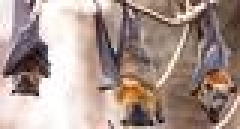 To help celebrate the 2010 United Nations International year of Biodiversity , the Logan and Albert Conservation Association will be hosting a series of free public workshops entitled 'Spotlight on Wildlife in the Scenic Rim'. The workshops have been funded through a Community Environment Assistance Grant from the Scenic Rim Regional Council.
The first 2010 WORKSHOP will be held in Canungra where there is a significant colony of bats and where recently there was a crisis to save the babies after a storm devestated their usual bat family nursery habitat. The workshop will help us all to become more aware of the signifigant contributions this family of flying marsupials makes to our shared environment and how we can all live safely and harmoniously together.
The Canungra workshop will include guest speakers Louise Saunders from Bat Care Brisbane Inc, Janet Gamble from the wildlife section of the RSPCA and local zoologist Ronda Green.
Professor Jonathan Hill, the head of the school of Veterinary Science at the University of Queensland, says once a Hendra virus quarantine has been lifted, any concern about any of the horses on property where Hendra virus had been is misplaced. It is indeed uncessary misfortune to have sound horses devalued as a result of exposure. When people who contact or walk into infectious diseases and don't get the disease, we know that they are not infected. Professor Jonathan Hill says the horses are not damaged goods just because they have been on a stud which had horses that had Hendra virus. In fact you could say that they have been tested to be 100 per cent certain of being clear, which puts them in a unique spot.
Professor Hill says such misconceptions stem from a lack of knowledge about Hendra virus, which need to be addressed with research.
Australia's unique biodiversity is under threat and needs your help.
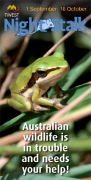 Tiwest Night Stalk runs from 1 September to 16 October with the aim of getting members of the community out into nature to do some spotlighting for wildlife.
In previous years, this community action program has focused on marsupials and introduced species but now its scope has been broadened to include all animal species, native and introduced. Each year will focus on a particular group of animals. In 2009 Perth Zoo is asking Tiwest Night Stalkers to keep a keen eye out for unique bird species.
Tiwest Night Stalk is easy, fun and something everyone can do. All you need is a torch and the Spotter's Log. Choose a night or number of nights between 1 September and 16 October and spotlight in your local bushland. Record all the mammals, birds, bats, reptiles and frogs that you find and then send your Spotter's Log to Perth Zoo or email it in via the online form.
The information will be collated and made available online for interested members of the community. It is also sent to conservation agencies to help determine the number of animals still living in the wild, especially near urban areas, to better direct conservation efforts. This regular monitoring can provide a valuable record of changes to the distribution of animals over time and help the community realise which species live in the various habitats surrounding them.
Tiwest Night Stalk is a great way to become involved in community conservation action and to learn about our native animals, their habitat and their threats.
Get involved and more information can be found on Perth Zoo website.
A public memorial for passionate Queensland naturalist Ric Nattrass will be held at the Queensland Museum at South Bank on Saturday morning, 24 October 2009.
Ric founded the Queensland Frog Society in 1990, also the Australian Dragonfly Society and the Ipswich Koala Protection Society.
Ipswich City Council named a stand of old growth forest at Bellbird Park the Ric Nattrass Environmental Park in honour of his advocacy work and recognition of his enormous contribution to conservation and the environment.
The Australian Frog Society's president Glen Ingram paid tribute to him in the society's Spring newsletter. "Over his life Ric has made thousands just as passionate about the living world as himself," Mr Ingram wrote.
The memorial will be held in the Whale Mall at the Queensland Museum from 11am.
Copies of his book and posters will be available, with proceeds going to his estate.
Ric was held in very high regard by the many individuals, groups, associations, and government bodies he met with on a regular basis. People from diverse walks of life - indigenous, government, conservation, science, tourism, as well as the wider community - will miss Ric's incredible depth of knowledge, larrikinism, laughter and sense of ethics. Read more at his website http://drivingyouwild.net.au/
A group of Scenic Rim residents have been meeting to discuss matters relating to wildlife in Scenic Rim Regional Council area - all 4000 square kilometres of it. They are investigating forming a branch of WPSQ in the future.Some of the group are members of WPSQ as well as a member of Logan and Albert Conservation Association LACA.
Meanwhile one of the members is hosting a website page.
You can find that here http://hennievandyk.bravepages.com/ScenicRimWildlife/index.html
Coming events will be listed on calendar as much as possible. This page has events for October - November 2009.
Contact Ronda Green (55454 1283 or platypuscorner@bigpond) for more information.
LACAs website be inclusive of this group's activities and members of both groups are welcome to participate at activities meetings etc for each group.
 Barry Fitzpatrick's observations.
My animal of the month is (I think) a bird - the Pheasant Coucal. This noisy, clumsy, brash bird has whooped, clicked and hissed around our house for the past six months.
Nothing about this bird makes much survival sense. It spends a lot of its time waddling around on the ground like a lizard (a link, perhaps?), flies clumsily, and crashes into bushes or anything nearby when it wants to (or has to) land. But it must be admired for its alluring black breeding plumage, the intensity of its mating efforts, and the dedication it shows in securing food of all sorts for its young in the nest somewhere deep in grass tussocks on the adjacent Cornubia Wetland Reserve.
My admiration grew even greater as I watched it one day marching a large goanna away from its nest and off its patch. The goanna was clearly in for a feed of easily reached fresh eggs, but was completely intimidated by the strutting, clicking, bristling pheasant coucal and just did as it was told and went.
 Trixie tells of her recent visit to a dedicated team of wildlife carers at Canungra where baby bats rest in shirt pockets where their progress is monitored.
Canungra Camp - 24 November 2008
Cruising south bound towards the Gold Coast Hinterland where Trish's property is located one could not help but notice how the landscape had been transformed. From parched brown to lush green: a sight not seen for a very, very long time, thanks to the heavy but welcomed constant rainfalls over the past couple of weeks.
We ascended Trish's steep winding driveway that lead us to her home nestled high in the hills. As Paulette and I emerged from the car I took in the sight of Trish's acreage with its rolling hills and deep valleys. My first visit was filled with images of tall mature trees, water filled dams and the collective sounds of the wildlife. I could hear the distant calls of the currawongs, the crack of the whipbirds echoed in the hills, the familiar sounds of squabbling lorikeets and figbirds raiding fruit bearing trees. The land had a serene feel but within the walls of Trish's home a completely different story was exposed.
 As I stepped through the front door of Trish's the atmosphere inside was a far cry from what I had witnessed outside only moments before. Slouched in chairs were half a dozen bat carers with a new batch of babies that required their 3-hourly feeds. Babies lay on laps, cradled in arms and smaller ones were tucked into large pocket shirts.
These carers had been feeding throughout the night to meet the demands of their charges. Exhaustion had set in but there were still lots and lots of mouths to feed and the carers knew that only too well.
A little background history...As a matter of routine the Canungra Flying Fox colony was being checked out when a discovery was made - a drama that no one could have envisaged had unfolded. It is not uncommon to rescue a handful of baby flying foxes during the breeding season but when you are alerted to over three hundred starving, dying and dead babies of the vulnerable listed Grey Headed Flying Fox being abandoned by their mums it raises a grave concern. The Canungra Camp was in serious, serious trouble.
 An appeal has recently gone to the general community from Wildcare whose members - registered wildlife carers - are desperate for help after storms caused grey-headed flying foxes to abandon about 300 babies in the Gold Coast hinterland. The Courier Mail published the story explaining that 60 carers from the Gold Coast and volunteer veterinarians are working around the clock, feeding every four hours.
Carer Ms Trish Wimberley said "Normally, female flying foxes will go to the ends of the earth to save their babies so for this to occur, they are really in dire straits."
If you are interested in becoming a registered wildlife carer Wildcare's website http://www.wildcare.org.au/ has a great deal of information. If you are really keen to help now - today, there are many supporting jobs we can all do to free up the trained carers. Specific information about our native flying foxes is also available here http://www.wildcare.org.au/html/flying_foxes.htm
Don't try to rescue bats though - it's a delicate job that should only be attempted by a trained and vaccinated carer. Contact Wildcare on 5527 2444 for help with rescue of any native animal.
The flying fox or bat is an essential creature of the rainforests. Bats distribute seeds across hundreds of kilometres to ensure our rainforests can regenerate. One wildlife group has the motto 'no bats, no trees, no koalas' and it's true - without bats you would literally have plagues of insects and eventually our rainforests would die. For such a small creature they do a mighty big job.
DROP OFF POINTS in SEQ for fruit, Karicare baby formula and soft cloths
Redlands - Patti Durnin - 0418 883 890
Kooralbyn - Pam Elliott - 5544 6762
Logan - Trixie Benbrook - 3207 3512.

FRUIT JUICE - BUT NOT CITRUS OR PINEAPPLE - NOT FRUIT IS CURRENTLY NEEEDED - Saturday 13 December 2008 update
We have been advised that 332 babies are in care at the moment... so we are still asking for help...
We desperately need non vaccinated volunteers to do general duties like making formula, washing, sterilising bottles, cutting up fruit and more - if you are part of an organisation that can pool together to help out contact Trixie asap on 3208 3512
Still need fruit JUICE, washing powder (environmentally friendly, please) and towels AND non vaccinated volunteers to do general duties
If you can help in any way it would be appreciated... Wildlife carers are a very special dedicated group of people who pay for the care and welfare of all species of our native wildlife as well as feeding round the clock when needed. Have a look at their OZARK website for more information.
To make a tax deductible donation please use the following information
 Extra hands are desperately needed on site to assist the carers -
NO VACCINATION NEEDED FOR GENERAL HELPING JOBS
- sterilising bottles and making baby formula, cutting up fruit.
PLEASE VOLUNTEER whatever time you can - all assistance is vitally important and much needed. Each minute volunteered - frees up bat carers to give care to our flying fox orphans.
200 - increased to 300 grey bubs from Canugra Camp came into care suffering dehydration, exposure, maggots and various stages of pneumonia. Hundreds of these orphaned baby flying foxes are down due to the aftermath of the violent storms, heavy winds and constant rain. Our grateful thanks go to the many tired and very dedicated carers who lovingly attend to our wildlife. Our native baby bats need around the clock feeding - taking time and patience.
Thank you for all the donations that have been and are being received including three dryers. The broken washing washing machine has generously replaced. Many thanks to those donors. Updates will be added re large items.
ALWAYS needed are food - boxes of fruit - apples, pears, rock melon, grapes but not citrus please and Kari Care - human baby formula - birth to 1 month.
A Wildlife Workshop on the topic of "the role of the amateur naturalist in science and conservation" was held on 7 June 2008. This event was hosted by Wildlife Tourism Australia with speakers from both Logan and Albert Conservation Association LACA and WTA.
 Tricia Belcher, a professional nature photographer
 as first speaker described her interest in nature photography and its importance to document animal and plant life for a number of reasons.
She displayed a number of her photographs in particular their importance in relation to documenting events such as the recent aerial spraying incident in Kerry Valley that has had such devastating effects on the environment.
Local zoologist Ronda Green delivered an informative address. She is particularly keen to establish a local natural history group to encourage and support wider community observation and recording skills of our sometimes elusive wildlife. More information will be posted soon. You can contact Ronda Green at This email address is being protected from spambots. You need JavaScript enabled to view it. or 5544 1283 if interested.
The fate of the kangaroos on defence land in the ACT was discussed across the globe in newspapers and blogs. The volume of protests has presently stayed the cull and management of the confined native animals is still a challenge. The Australian Science Media Centre (AusSMC) publishes the thoughts of scientists on its Science Blog page. In the latest series of blogs, two scientists give their views about the vexed issue of the proposed kangaroo cull in the ACT.
Other documentation that can be considered is available from the RSPCA campaign website and their report known as the Kangaroo Shooting Code Compliance Report which is available online at www.environment.gov.au/biodiversity/trade-use/publications/kangaroo-report/index.html
FaunaNet is an online gateway to resources and expertise in biodiversity and conservation. The Australian Museum's Centre for Biodiversity and Conservation Research (CBCR) has coordinated the resources of FaunaNet into five modules.The site is here.
The Australian Museum has unique and extensive collections of natural science and cultural artefacts. The Museum's Centre for Biodiversity and Conservation Research (CBCR) is committed to the investigation and conservation of biodiversity. The internet provides a powerful means for the Centre to communicate its research results, and to provide both the scientific and broader communities with access to information on the biodiversity of NSW. To this end CBCR has developed a website dealing specifically with the Fauna of NSW - called FaunaNet. FaunaNet includes the following components:
FaunaNames
FaunaNames provides easy access to the New South Wales Master Names List (MNL). The MNL is a list of the valid scientific names of animals found in New South Wales. It is the ideal tool for taxonomists, systematists, biologists and ecologists to access knowledge of the scientific nomenclature and classification of the fauna of New South Wales. CANRI funding assisted in the development of this site.
FaunaMap
FaunaMap is the Australian Museum's online fauna mapping system. Through FaunaMap the user can: create maps showing the collecting location of specimens held in the Australian Museum fauna collection and obtain a list of the species held in the AM collections, from specific Local Government Areas, Bioregions, National Parks or Mapsheets.
Invertebrate Resources
A database of resources focused on the field of invertebrate research and discovery. The database includes websites, books, CD's, journals and online keys, as well as organisations devoted to invertebrate research and conservation.
FaunaKeys
This site provides access to a range of taxonomic keys for identifying selected invertebrate and vertebrate groups in New South Wales and Australia. The illustrated interactive keys combined with information pages and photo images of taxa provide hands-on education for both beginners and professionals in the field. CANRI funding assisted in the development of these keys.
Wildlife of Sydney
Wildlife of Sydney provides natural history information on a wide variety of animals that might be encountered in and around Sydney. The site allows Sydneysiders and visitors access to information about the great biodiversity that surrounds them. As well as about 400 species profiles the site describes the habitats where the animals and has a number of interactive features including games and a quiz which are based on aspects of the animal's biology or an ecological theme.